

You were under a sink when the phone buzzed. A web form, a name, a number, a job worth six hundred dollars. You called back at six that evening and got voicemail. The number went on the back of an invoice, and nobody in your shop thought about it again. Two weeks later the same customer posts a photo of the finished work, done by somebody else.
I am Daren Hirsch. I built Catch CRM after years of watching service businesses buy leads and then touch them once. The question I get asked most is some version of "how many times am I supposed to call these people before I stop?" This post gives you a real number, a schedule you can copy, and the rules that decide how late you are allowed to dial. By the end you will know how many attempts a new lead takes, why five of them is not rude, the day-by-day cadence I use, what the law allows for calling and texting, and what the last message should say.
Call a new lead back inside the first minute, then plan on 6 to 8 total attempts spread across about 14 days, mixing phone calls with texts and one voicemail. The first attempt wins the most jobs by far, and the rest exist because people are busy, screening, or still collecting quotes. Stop early only when they ask you to stop.
Key takeaways
- Attempt one belongs in the first minute, not the first evening. Nothing else in this post matters as much as how fast the first call goes out.
- Six to eight touches, front loaded. Half of them go out in the first 24 hours. The tail exists for people who were driving, on a roof, or at work.
- A call alone is not a touch. Only 19% of Americans say they generally answer a call from a number they do not recognize, though 67% will not answer and still check the voicemail, according to a Pew Research Center survey published in December 2020. So the voicemail and the text do the work the ring cannot.
- If it feels like slightly too much, you are close to right. The point of the sequence is to get a yes or a no. Silence is the only outcome that costs you money.
- Federal rules set the outside edges. Calls are limited to 8 a.m. through 9 p.m. in the customer's local time, and an opt-out has to be honored within ten business days.
I have set up this sequence for plumbing, HVAC, garage door, and locksmith shops, and the pattern below is what holds up across all of them.
"I do not want to bother them" is what is costing you jobs
Every owner I show this schedule to says a version of the same thing: five messages feels like too much, it looks desperate, it will make us look unprofessional. The instinct is backwards, and it is expensive.
Start with what actually happened. They came to you. They typed their name and phone number into a form and asked for a price, then went back to work. That is not a stranger you cold called, that is a person who raised a hand and got busy. Treating busy like rejection is a decision you made, not one they made. Meanwhile they filled out two other forms that afternoon, and the shop that got them on the phone with a real time and a real price took the job.
Then look at who follows up the hardest. Opt into the website of the biggest operator in your market, the one with forty trucks, and count what shows up on your phone over the next week. A call, a voicemail, several texts, and an email list you stay on for years. The companies with the most brand to protect push the most, because they are not protecting an image, they are chasing an answer.
That is the reframe. You are not talking somebody into a water heater, you are getting a yes or a no. A no is a fine outcome: it frees the slot, it tells you what that lead source is really producing, and it costs the customer four seconds. Silence is the only result that costs you money, and silence is what one call and a hope produces. If a message ever bothers somebody, they have a one-word way to shut it off and you have to honor it fast, which is covered below.
The 8-touch cadence I use over 14 days

- Minute 1: call. The lead form is a raised hand. Dial while they are still on the page. This is the single attempt that decides most of your booking rate, and how fast you get to it matters more than everything after it, and it is the one worth automating with an autocall dialer so it never depends on who is free.
- Minute 2: voicemail plus a text. Say your company name, the service they asked about, and the time you can be there. Then send the same thing by text so it sits on their screen. Given how few people pick up for an unknown number, this pair is what actually gets read.
- Hour 4: second call. Different part of the day, different odds. No voicemail this time.
- Next morning: call plus text. Morning catches the people who were at work when the form went in. The text carries a booking link so they can pick a slot without talking to anyone.
- Day 3: call. By now they have talked to competitors. Ask what they have been quoted and what they are unsure about. Half the time the objection is a schedule, not a price. If you are sending your own number after that call, it is worth knowing the difference between a quote and an estimate before you pick which one to write.
- Day 7: text. Short, useful, no pressure. A price range for the job type, or how long the part takes to come in.
- Day 14: the final message. Covered below.
That is seven scheduled touches plus the voicemail, and four of them go out in the first day. If a lead comes in at 11 at night, the sequence starts the next morning at 8, for reasons in the next section.
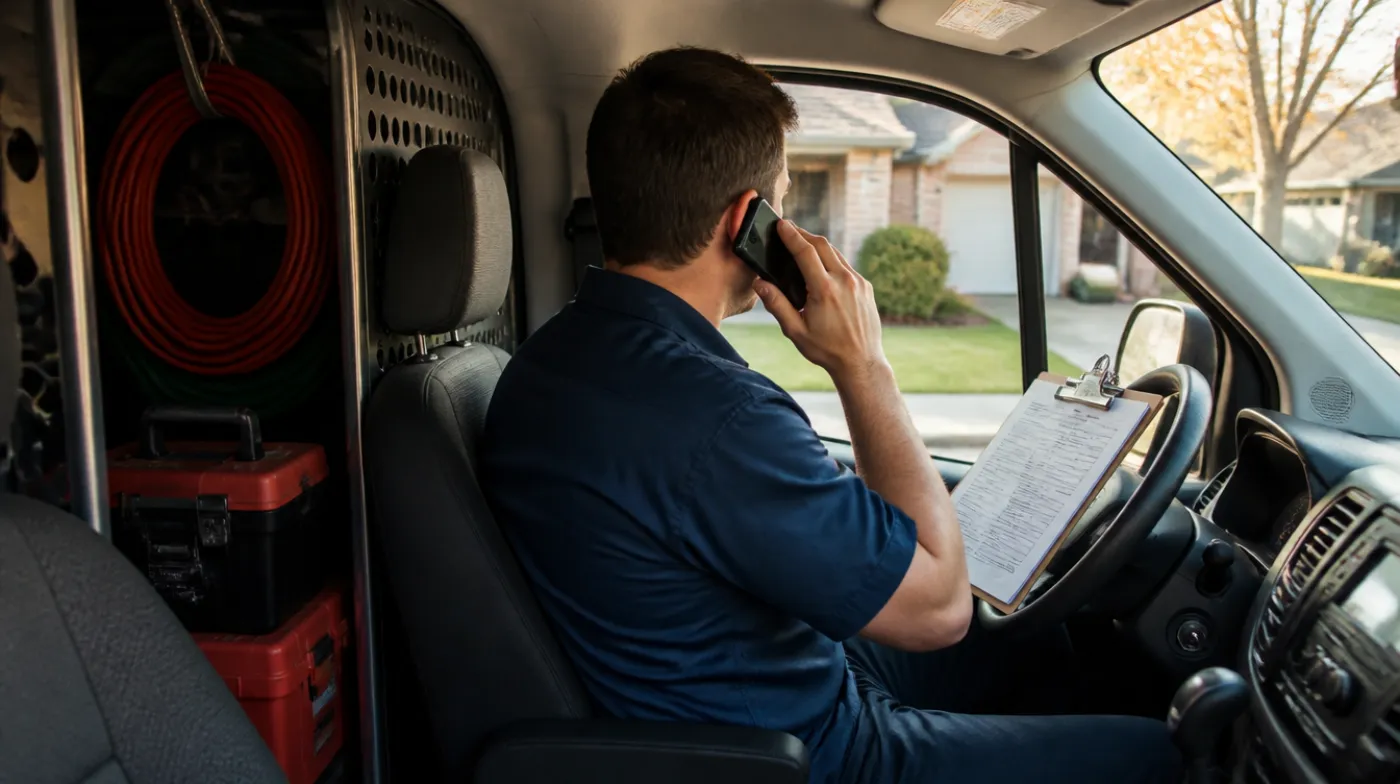
Attempts three and four exist because of this: the customer was on a roof, under a house, or driving when the first two calls rang. Spreading attempts across different parts of the day is what catches them, not calling twice in a row.
Every touch needs a job, not a check-in
The count is only half of it. Five messages feel like pestering when all five say the same empty thing, and "just checking in" is the worst offender because it hands the reader nothing to respond to. It reports that you are still here. That is your news, not theirs.
Give every touch one job, and give the customer one new thing they did not have before they read it:
- First contact: get the appointment. Name the service they asked about and offer two real times. Not "when are you free," which hands them the work. "I can be there tomorrow at 9 or Thursday at 2" gets a one-word answer.
- The early follow-ups: make it easy to say yes. Send the booking link so they can grab a slot at 11 at night without talking to anyone, or ask for a photo of the unit so the visit runs shorter. Replying should be easier than ignoring.
- Midway: give them a number. A price range for that job type, or what the diagnostic costs and whether it comes off the repair. A lot of the silence here is somebody bracing for what the visit will cost, and a range answers that before anyone drives out.
- Late: give a real reason it matters now. Which days are actually left this week, how long the part takes to come in, what the same work costs in your slow season. Invented urgency reads as invented, and customers have seen plenty of it.
- The last one: give them the easy out. Say you have tried a few times, that you are closing the request here, and that a reply reopens it. Naming the follow-up is what makes the follow-up acceptable.
Tone rides along with that. Early messages are warm, the middle ones nudge, the late ones ask when instead of whether, and the last is plain. Read each message and ask whether the customer could screenshot it and make you look bad. Direct passes that test. Impatient does not.
The 5 rules I follow on every attempt
- Call from the same local number every time. Rotating numbers get flagged as spam and buried by carrier filtering, and getting that label removed takes weeks. One number, used consistently, is how a customer learns to recognize you.
- Leave exactly two voicemails. One on the first attempt, one on the last. Voicemails three through six do nothing but annoy.
- Text right after the call, not instead of it. The call is the attempt. The text is the receipt, because it survives the missed ring and gives them a way to answer with one thumb.
- Do not run the whole sequence down one wire. Some numbers on your forms are landlines, and every text sent to those goes nowhere with no bounce to warn you. Carriers drop texts the same silent way when your business number was never filed, which is what 10DLC registration fixes. Plenty of older customers answer calls and never open a text thread, while younger ones ignore the ring and reply to a message in seconds. Calls only, or texts only, drops a share of your leads for a reason that has nothing to do with interest.
- Log the outcome or the sequence eats itself. Every attempt needs a result on the record, or somebody calls the customer twice in an hour and somebody else never calls at all. This is the whole reason follow-up belongs in lead management instead of a notes app.
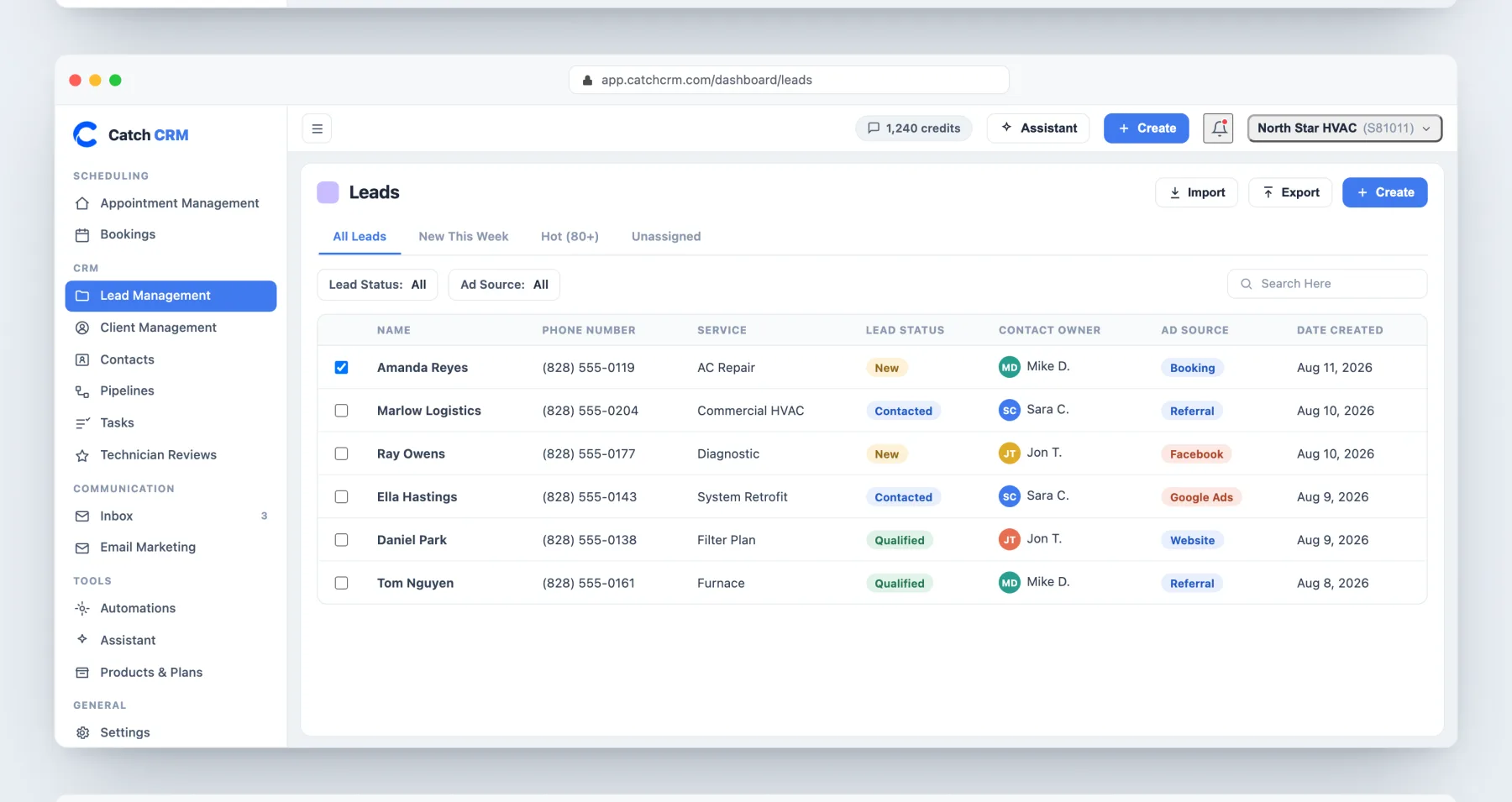
Three columns decide whether a cadence survives contact with a busy week: the status, the one person who owns the lead, and the date it came in. Without an owner, attempt three belongs to nobody.
What the rules let you do

Three limits shape the cadence above. All of them come from the same federal rule, 47 CFR 64.1200, which carries out the Telephone Consumer Protection Act.
- The calling window is 8 a.m. to 9 p.m. The rule bars a telephone solicitation to a residential subscriber "before the hour of 8 a.m. or after 9 p.m. (local time at the called party's location)." Local time means theirs, not yours, which matters the moment you take work in a second time zone.
- Their inquiry gives you a three-month window. The rule treats a prior relationship as established "on the basis of the subscriber's inquiry or application regarding products or services offered by the entity within the three months immediately preceding the date of the call." A 14-day cadence sits well inside that.
- An opt-out has to be honored within ten business days. The same rule lists the words that count, including stop, quit, end, revoke, opt out, cancel, and unsubscribe. A reply with any of them ends the sequence, and your system has to act on it fast.
One piece is still moving. The provision that would make a single opt-out apply to all of a company's future calls and texts on unrelated subjects is not in force today: the FCC's Consumer and Governmental Affairs Bureau pushed that date to January 31, 2027 in an order released January 6, 2026. Build your list as though it already applies, and check the current status with your own attorney, because state rules can be stricter than the federal floor.
When to stop, and what the last message says
Stop when they opt out, when they tell you they hired someone, or when the fourteenth day arrives with no reply. Past that you are not persistent, you are the reason your number gets marked as spam. The final message is the only one that asks for a no, which is why it pulls more replies than anything else in the sequence:
"Hi Maria, it's Daren at Northside. I'll close out your water heater request so I stop filling up your phone. If you still want that quote, reply anytime and I'll pick it right back up. Thanks either way."
Plenty of people answer that one to say they already booked somebody. That is worth knowing too, because it tells you the lead source is fine and your speed is not.
Where the follow-up goes after day 14
Closing the sequence is not the same as deleting the person. Somebody who never answered in two weeks was often at a one percent interest level the day they filled out the form: pricing a job for next spring, waiting on a spouse, waiting on money. None of that means never.
So the name moves out of the fast cadence and into the slow one. A seasonal note, a maintenance reminder, and a review request if you ever did work for them. In your slow months, take everyone who came in during the rush and never booked and send one message about doing the work in the off season, when your crew is open and your pricing can be. A small reply rate across a few hundred old names is real money on leads you already paid for, which is how shops that keep this up end up getting more work from their own list than from new ad spend.
Make the cadence run without you
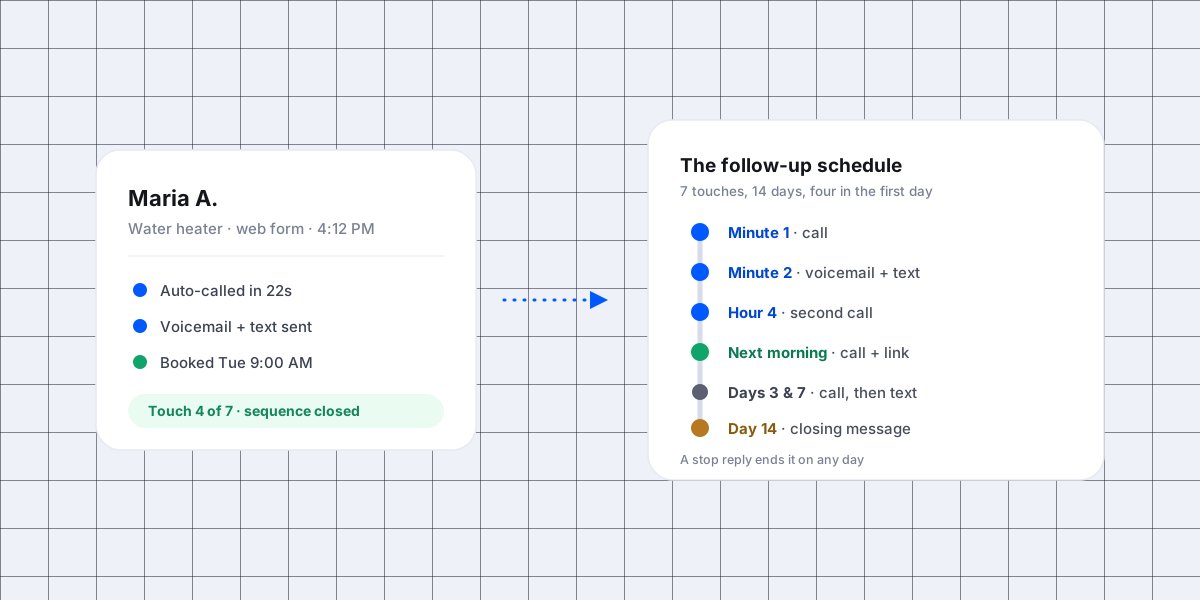
What it looks like when the schedule is running: the lead record on the left, the queued touches on the right, and the sequence closing itself the moment she books.
None of this survives a busy Friday if a person has to remember it. The reason we built the autocall dialer and the automation builder into Catch CRM is that the first minute cannot wait for someone to be free, and touches four through eight will not happen on their own. A new lead from a form, a call, or Facebook lead ads gets dialed in under 30 seconds, the voicemail and text fire behind it, the rest of the schedule queues itself, and a stop reply shuts the whole thing down.
FAQ
How many times should you call a lead before giving up?
Six to eight total attempts over about two weeks, with roughly half of them in the first 24 hours. Fewer than that and you are quitting on people who were simply busy. More than that, past a clear no or an opt-out, and you are risking a spam flag for nothing.
Is it rude to text a lead five times?
Not when they asked you for a price and every message carries something new: two real times, a booking link, a price range, a part lead time, an easy out. What reads as rude is "just checking in" sent five times, or messages that keep coming after someone says stop. Say plainly in the last one that you have tried a few times and are closing the request out.
Is it better to call or text a new lead?
Both, in that order. Call first because a live conversation books the job on the spot, then text within a minute or two so there is something on their screen if the call went unanswered. Pew Research Center found in 2020 that most Americans do not pick up for unknown numbers, so the text is what makes the call attempt visible.
What time can you legally call a new lead?
Federal rules limit telephone solicitations to between 8 a.m. and 9 p.m. in the local time where the customer is. A lead that comes in at midnight waits until 8 a.m. Some states set tighter hours, so check your own before you set the schedule.
How long should you wait between follow-up calls?
Hours at first, then days. My spacing is minute one, hour four, next morning, day three, day seven, day fourteen. Attempts stacked back to back inside one hour read as harassment, and a first call that waits until tomorrow has already lost the job.
What should the last follow-up message say?
Tell them you are closing the request, give them one line to reopen it, and thank them either way. Asking for a no gets more replies than asking for a yes, and it leaves the door open without another call.
Book the leads you already paid for
If your leads are getting one call and a hope, the fix is not more ad spend. It is a first attempt that happens in seconds and a follow-up schedule that runs on its own. Get a free demo and we will show you the cadence running on a real lead, or see the plans first. There is a free plan for up to 300 contacts, so you can put this sequence to work before you spend anything.